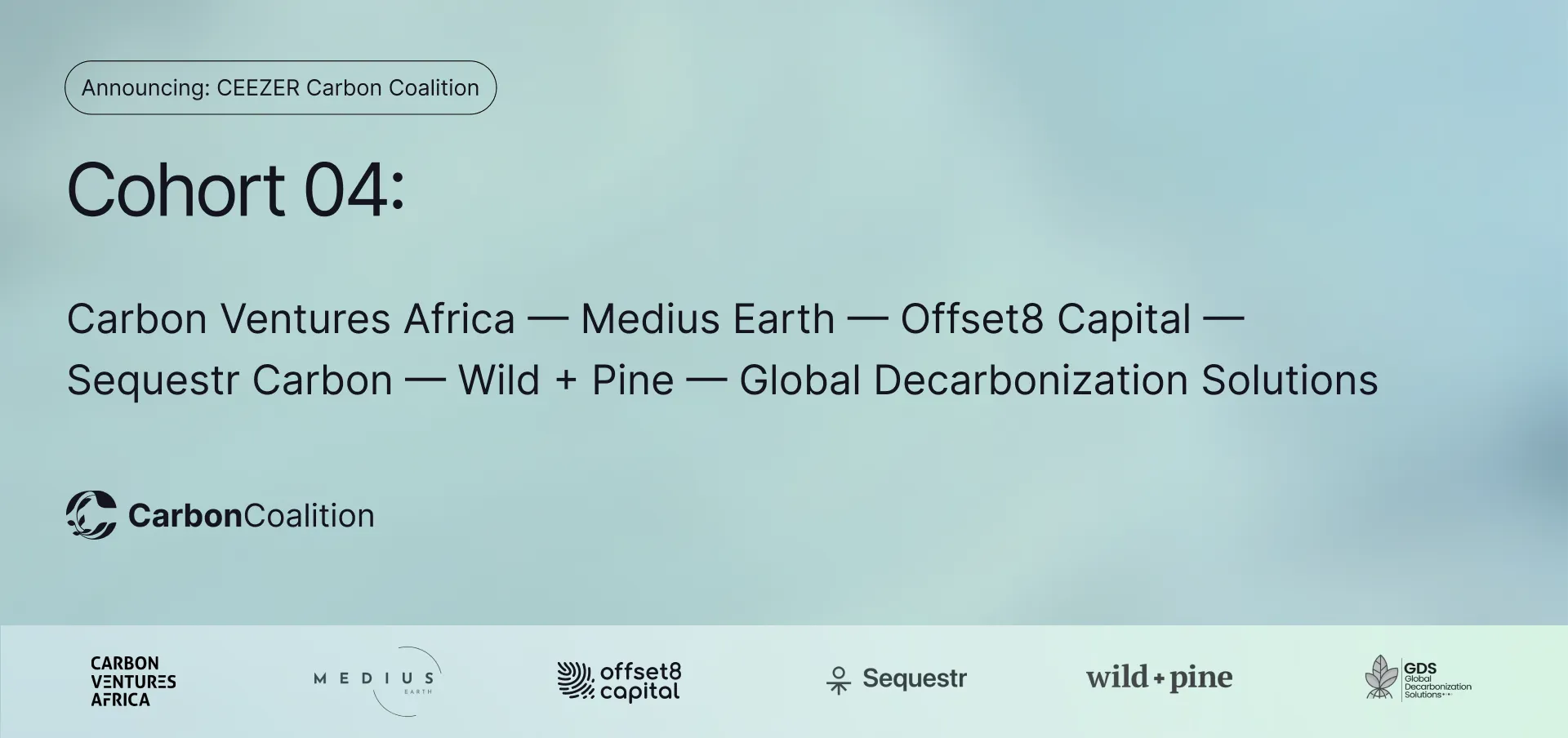

Selected from more than 50 global applicants, these ambitious, early stage companies represent ecosystem restoration and blue carbon projects from six different countries.
March 19, 2026 — CEEZER today announces the selection of six early stage, Nature-based Solutions (NbS) project developers for the fourth cohort of its Carbon Coalition accelerator program. In its first-ever program dedicated to NbS, CEEZER received over 50 applications from 27 different countries.
The CEEZER Carbon Coalition program empowers start-ups in the voluntary carbon market and bridges the gap between ideation and commercialization. The program addresses the challenges typically faced by project developers, such as increasing buyer awareness; understanding buyer needs; Digital Monitoring, Reporting, and Verification (dMRV); and navigating registries, inventory management, and pricing.
“We see a lot of dynamics at play in the NbS space, including high buyer interest, long-term contracts, and a relatively low share of high-integrity NbS removal projects. These complexities are compounded by more rigorous protocols, the rapid evolution of dMRV solutions, increasing buyer scrutiny, and a changing regulatory landscape. This presents a challenge, as well as an opportunity, for ambitious NbS project developers. This edition of the Carbon Coalition is specifically designed to support developers in navigating this next phase of the NbS market and unlocking its significant untapped potential,” explains CEEZER's Chief Impact Office, Dr. Carla Woydt.
Introducing Cohort 04, the first nature-based cohort, of the CEEZER Carbon Coalition
.webp)
The CEEZER Carbon Coalition welcomes early-stage project developers with innovative, scalable carbon dioxide removal (CDR) and NbS. The program is tailored to early stage companies who are looking to commercialize, successfully enter the carbon markets, and rapidly begin scaling their carbon removal capacity by issuing high-quality carbon credits.
For Cohort 04, first NbS cohort, the most used project types within the applicant pool included:
- 41.8 percent ecosystem restoration
- 25.5 percent soil carbon and agriculture
- 14.5 percent blue carbon
- 3.6 percent improved forest management
- 14.6 percent other
Here are the six early stage companies joining Cohort 04 of the CEEZER Carbon Coalition:
Medius Earth provides community-owned restoration projects in India with a complete operating system: technology for project management, dMRV, and high-integrity implementation design, plus access to institutional carbon buyers and financing. Learn more
Wild + Pine is developing the StoneWoods Forest Carbon project, a Canadian afforestation carbon removal project, built for sophisticated climate leaders who recognize the power, scale, and security privately managed forests deliver. Learn more
Offset8 Capital Limited is the financing and structuring partner for iRise’s Climate and Community Transformation Program, a project led by iRise to restore former cropland in Malawi through large-scale afforestation and reforestation. Learn more
Sequestr’s ‘Niger Delta Community-Driven Mangrove Restoration Project’ will restore degraded mangrove ecosystems across Nigeria’s Niger Delta—one of Africa’s largest mangrove landscapes—starting with 5,000 hectares and designed to scale significantly in future phases. Learn more
Carbon Ventures Africa is developing Miombo Renewal, a project restoring over 200,000 hectares of degraded miombo woodlands across the "Grand Katanga" region of southeastern DR Congo - one of Africa's most significant landscape restoration initiatives. Learn more
Global Decarbonization Solutions' 'Pesisir Biru Nusantara' Indonesian Mangrove Restoration Project is a large-scale afforestation, reforestation, and revegetation initiative restoring up to 30,000+ hectares of degraded mangroves along coastlines and river deltas to benefit biodiversity, provide coastal protection, and create local employment. Learn more
Selection criteria for Cohort 04
.webp)
From a pool of over 50 high-quality applications, this final cohort of projects was selected based on key criteria CEEZER uses to identify early stage companies with the greatest potential for success:
- Impact potential: Demonstrated ability to deliver real, scalable carbon removal with a clear roadmap for expansion as carbon finance is unlocked.
- Socio-environmental integrity: Clear commitment to deliver verifiable biodiversity gains and socio-economic benefits for local communities, evidenced by a clear path toward co-benefit certifications, verified FPIC (Free, Prior and Informed Consent) processes, and transparent benefit-sharing models that ensure long-term value for local communities and ecosystems.
- Market viability: Clear market demand for carbon credits at competitive, sustainable pricing that supports business growth.
- Innovation: Unique approach that brings fresh solutions to the voluntary carbon market.
- Team strength: Proven expertise, appropriate skillsets, and a robust implementation plan for long-term success.
- Program alignment: Positioned to maximize benefits from the accelerator resources and support.
“After three successful cohorts supporting project developers for durable CDR technologies, we're thrilled to open this program to the Nature-based Solutions space. The carbon markets are home to an incredible range of innovative projects dedicated to restoring natural carbon sinks and transforming environmental practices. With all technologies needed to reach net zero, this fourth cohort is our chance to tailor our support specifically to NbS projects for the very first time," says Woydt.
Addressing market entry challenges
The CEEZER Carbon Coalition directly responds to the growing demand for high-quality carbon removal solutions. By providing resources and support to access enterprise-level customers, the program helps promising, early stage project developers overcome critical commercialization barriers.
Applicants consistently identified significant hurdles in transitioning from project design to commercial viability:
- Commercial connectivity: Many of applicants cited "direct access to high-quality buyers" as their primary challenge, noting the difficulty of building trust in a market characterized by intense scrutiny.
- Methodological navigation: Many developers expressed frustration with the "rapidly shifting goalposts" of carbon crediting methodologies, specifically regarding dMRV integration and evolving registry requirements.
- Price discovery and inventory strategy: A recurring pain point was the lack of data-driven insights into "fair market pricing," leaving developers uncertain on how to value their credits against legacy projects.
The program addresses these priorities while tackling what applicants cited as their three biggest challenges: securing funding, generating market interest, and connecting with committed buyers.
CEEZER is always looking for the next generation of groundbreaking project developers, whether established or just starting out. The application window for Cohort 05 is expected to open in late 2026. To learn more, visit the CEEZER Carbon Coalition program page and subscribe to receive updates on the next application window.
About CEEZER
CEEZER is the leading partner for Climate Performance Asset procurement and management, empowering organizations to transform climate ambition into a clear path to net-zero. It offers transparent access to high-quality carbon credits, Energy Attribute Certificates (EACs), and Sustainable Aviation Fuel Certificates (SAFc) worldwide, combining proprietary risk assessment technology with expert guidance. CEEZER’s industry-leading platform supports enterprises in designing, procuring, and managing Climate Performance Asset portfolios tailored to their sustainability goals, enabling real-time monitoring, framework-compliant reporting, and multi-stakeholder engagement.
Trusted by major organizations including Deutsche Telekom, LGT, and Nasdaq, CEEZER provides the confidence needed to implement effective climate action strategies. For more information, visit ceezer.earth.







.png)