


A single buyer reviewing its portfolio is not a market collapse. Here’s what is actually happening, what it means for the market, and why the long-term signal remains strong.
Microsoft recently paused new carbon dioxide removal (CDR) purchases - and the reaction across parts of the carbon market has been loud. While that reaction is understandable, it does not hurt to be nuanced in the interpretation of this news - particularly given that Microsoft has not publicly disclosed its full reasoning.
Microsoft has contractually secured close to 90 million of the roughly 120 million tons of all-time CDR offtakes, single-handedly accounting for approximately 75% of the entire market's forward volume. It has been - and is - an extraordinary buyer, and has now contracted the large majority needed to back its existing climate targets. One plausible explanation for the pause, having reached this point, is to review and optimize the remaining portion. In this case, it is not a retreat from climate ambition, but rather what responsible portfolio management looks like. It is also exactly what we advise any serious, long-term buyer to do at this stage.

A further factor that could help explain the decision is the impact of Microsoft's massive investment into AI and infrastructure. This may have increased the company's footprint significantly, meaning the target it is working toward could itself have been moving. At the same time, the leeway of reaching the target with existing offtakes may be getting smaller - and if that is the case, ensuring that the remaining volume is fully fit for purpose, deliverable on time, and in line with wider market development would naturally become more critical when approaching the last 10% of a foreseeable portfolio.
Whether this dynamic is indeed driving Microsoft's decision is unclear, but it is a reasonable lens through which to interpret the pause.
What this means for the carbon market
This news invites an honest conversation and reflection about what relying too heavily on Microsoft's dominance as a buyer means. A market with one buyer is not a market. For the carbon market to fulfill its true potential, it requires a diverse, committed buyer base across industries.
Successful CDR projects will continue to sell credits, although certain value drivers are shifting. This development will likely accelerate buyer focus on one value driver in particular: Long-term financial viability. Projects relying on single buyers or one long-term contract face considerable risk, something CEEZER already carefully screens for when evaluating projects.
While Microsoft’s early, strong offtake push created demand ahead of its time, enabling several notable projects to grow, new and committed CDR buyers have been building long-term viability and resilience for some time now. The market may see fewer headlines, but below the surface, this buyer base has been steadily increasing the share of CDR in diverse portfolios, and providing a solid funding base for early-stage projects.
Here is what matters most for buyers reading this: This market expansion and diversification is already happening, quietly and consistently. Microsoft may account for the majority of contracted volume, but of the 259 durable removal suppliers listed on CDR.fyi, Microsoft contracted only 39.
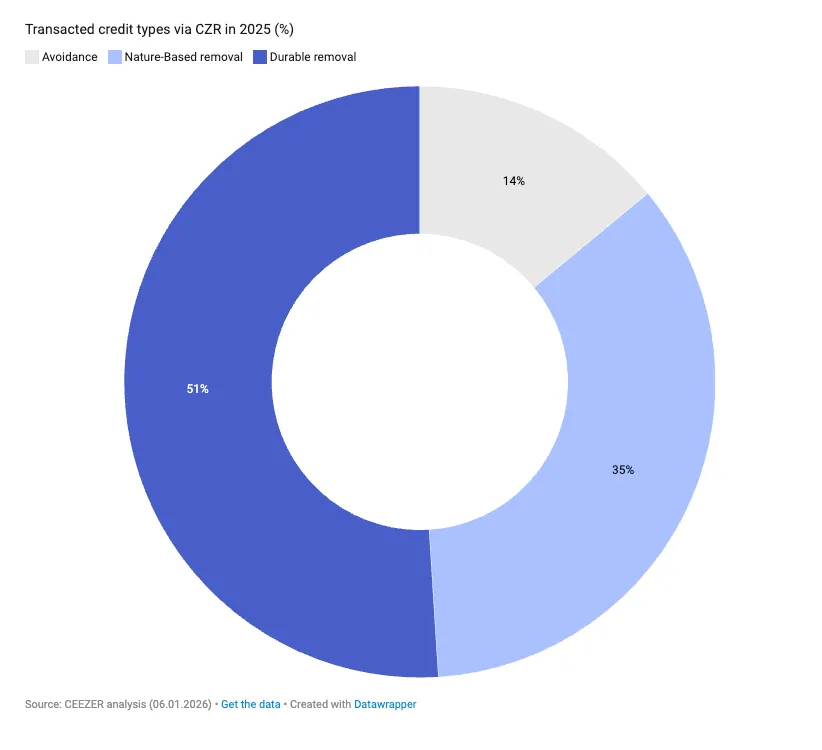
CEEZER has seen this development play out on its platform: For two years, buyers across sectors have been increasing their CDR commitments. Last year, permanent CDR made up over half of all traded carbon volume, with nature-based removal as the second largest bucket, together accounting for over 85% of total traded volume.
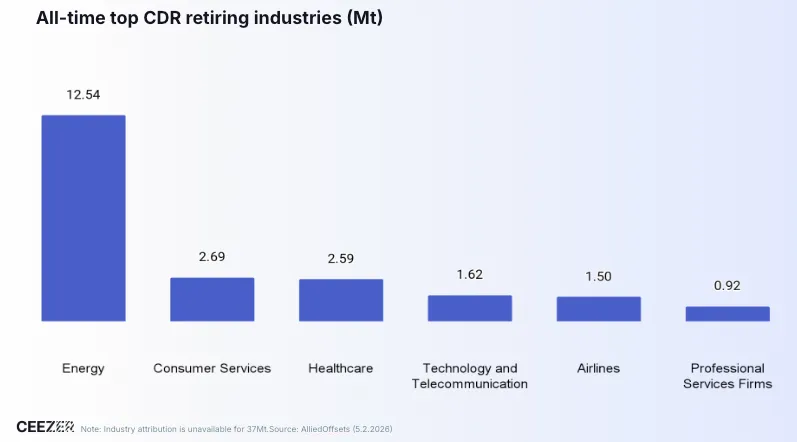
We have also seen that, when looking at actual retired and delivered all-time CDR credits, it has not been the technology sector leading the way - it is energy, consumer, and healthcare.
These are not headline-grabbing, single offtakes, but they do represent real production, delivery, and use of CDR. They indicate a durable, broad-based shift in how buyers across industries are building their portfolios. That is the signal that actually speaks for the emergence of a healthy long-term market.
What this means for CDR buyers
For buyers with active CDR commitments, the message is straightforward: stay the course, and use this moment as a prompt to review your own portfolio for delivery risk and diversification. Climate ambition has not changed. The underlying dynamics driving CDR demand have not changed. If anything, global market conditions are signalling a stronger commitment than ever to responsible, sustainable CDR investment.
In the first quarter of this year, various country-led initiatives have kicked off, changing political guardrails and public perception. These include:
- EU CRCF has become operational, providing a EU-wide certification framework for removal. Three methodologies have already been adopted, with more to come over the course of 2026, with an established buyers club being part of the initiative.
- Germany is finalizing the outline for a public procurement program for removal, with an anticipated start date in 2026.
- Canada launched a federal procurement program in the first quarter of 2026 to purchase removal credits from domestic projects.
It is true that Microsoft pausing its carbon removal purchases will be felt in the market. The loss of its steady stream of large offtakes is real — Microsoft has been a foundational force, at times single-handedly sustaining project developers who are now among the most successful and technically advanced in the field.
But to frame this moment as a crisis would be to misread how far the market has come. The CDR buyer-base is growing, diversifying, and maturing, and today's demand signals are both strong and clear. The market that exists now looks nothing like the one Microsoft stepped into years ago, and that is not coincidental. Microsoft's early and outsized commitment helped grow an entire ecosystem, and gave many in the broader buyer community the confidence to follow. That contribution does not pause if the purchase orders do.
The diversity of buyers entering the market now is precisely the outcome that bold, early movers like Microsoft made possible, and it is the strongest indicator that the CDR market momentum does not depend on any single buyer to sustain it.
If you’d like to take a look at your portfolio alongside an expert team, CEEZER looks forward to supporting you.







.png)